No Minimum Order Wholesale Clothing Vendors for Boutiques
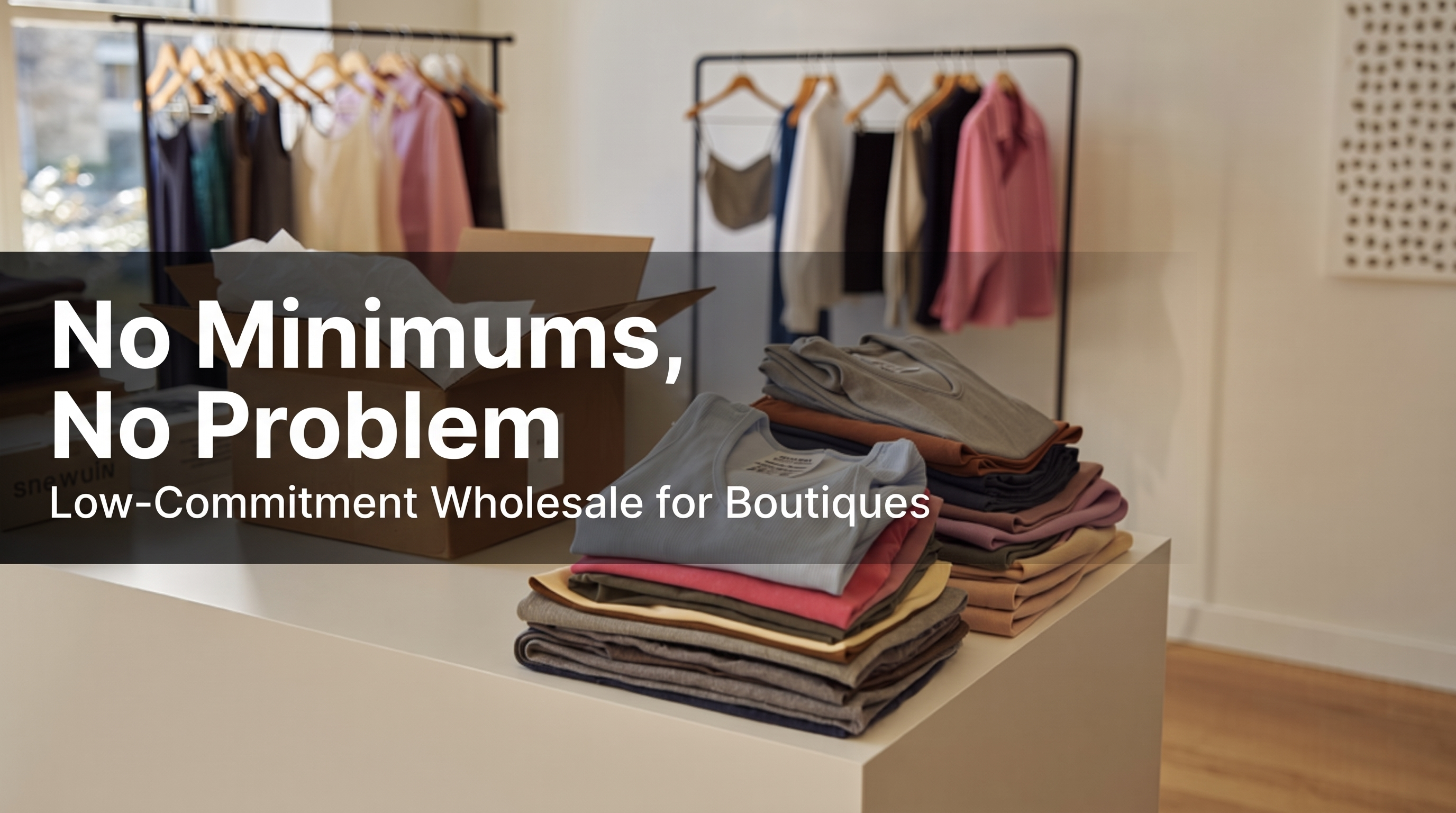
One of the biggest hurdles for a new boutique owner isn't finding beautiful inventory — it's the buy-in. Traditional wholesale often expects you to commit to hundreds of dollars per brand, in prepacks you didn't choose, before you know what your customers will actually wear. If you're testing your first collection, adding a new category, or simply managing cash flow carefully, wholesale clothing suppliers with no minimum order (or very low minimums) let you buy six pieces instead of sixty and learn as you go.
This guide breaks down what "no minimum" really means in the wholesale world, which suppliers and marketplaces currently offer true low-commitment ordering, and how to use small test orders strategically so low minimums become a sourcing advantage rather than a crutch.
What "No Minimum Order" Actually Means
Wholesale minimums come in a few different flavors, and vendors use the terms loosely, so it pays to read the fine print before you fall in love with a line sheet.
Dollar minimums vs. unit minimums
A dollar minimum is the smallest total order value a vendor will accept — 0, 0, 0. A unit minimum (MOQ) is the smallest quantity per style, often expressed as a pack. "No minimum" usually means there's no dollar floor on your order, but individual styles may still sell in packs.
Prepacks vs. open packs
Most junior and contemporary wholesale in the U.S. ships in prepacks — a fixed size run per style, typically six pieces (2 small / 2 medium / 2 large, sometimes 1-2-2-1 across four sizes). A vendor with "no minimum" may still require you to buy a full pack of each style; you just aren't forced to hit a dollar total across styles. Open pack ordering goes further and lets you choose your own mix of sizes and colors within a style — the most flexible arrangement, and the rarest.
First-order vs. reorder minimums
On marketplaces like Faire, brands set their own minimums and often maintain two tiers: a first-order minimum for new stockists and a lower reorder minimum once you've bought from them before. Faire's own documentation notes that reorder minimums are "usually lower than the first-order minimum," which means your second order with a brand is often much easier to place than your first.
Suppliers with No or Low Minimum Orders
Here's how the current landscape looks for boutique-focused women's apparel suppliers. Policies change, so always confirm on the vendor's site before ordering — but as of this writing, these are the standouts.
| Supplier | Minimum | Pack Style | Worth Knowing |
|---|---|---|---|
| Sugarlips | No minimum | Prepacks by style | 30-day return window; no private labeling |
| Wholesale Fashion Square | No minimum | Most styles in packs of 6 | .95 flat U.S. shipping, free over 0 |
| Trendsi | MOQ of 6 per color variant | Open pack — pick your sizes | Also offers dropshipping; wholesale shipping from |
| Dear Lover | No per-SKU minimum | Open pack | U.S. fulfillment hub with 3–5 day domestic delivery |
| CC Wholesale Clothing | 0 order minimum | Varies by style | Sources excess inventory, so pricing runs low |
| Faire | Set by each brand | Varies by brand | Net-60 terms for eligible retailers; free returns on opening orders |
| FashionGo | Set by each vendor; many low | Mostly prepacks | 1,300+ brands; per-vendor minimums shown on each storefront |
| OrangeShine | As low as 6–12 units per style | Prepacks | Private-label options available |
| LA Showroom | Batches from 8 units | Prepacks | Dedicated plus & tall category |
Sugarlips
The LA-based label behind those famously soft seamless basics accepts orders with no minimum at all, which makes it one of the easiest "real brand" entry points for a new boutique. You can bring in a single pack of a bestselling ribbed tank, see how it moves, and reorder with confidence. Note that Sugarlips doesn't permit private labeling and doesn't allow retailers to use its product photography — details we cover in our Sugarlips vendor spotlight.
Trendsi and Dear Lover: the open-pack option
If prepack size runs don't match your customer base — say you sell mostly S/M, or you're building a size-inclusive rack — open-pack suppliers solve a real problem. Trendsi's wholesale program carries an MOQ of just 6 pieces per color variant but lets you choose any mix of available sizes, and per-piece pricing drops once you hit 6 or more of a style. Dear Lover runs a similar open-pack model with no per-SKU minimum and ships domestic orders from a U.S. hub in roughly 3–5 days. Both also offer dropshipping, so you can test a style with zero inventory before committing to a wholesale buy.
Wholesale Fashion Square and CC Wholesale Clothing: the budget route
These two Los Angeles operations compete on price. Wholesale Fashion Square has no order minimum (most styles ship in packs of six) with .95 flat-rate U.S. shipping that goes free over 0. CC Wholesale Clothing asks only a 0 order minimum and keeps prices low by sourcing excess inventory from other manufacturers — good for value racks and sale sections, though assortments are less predictable than buying a brand's current season line.
Marketplaces: Low Minimums, One Checkout
B2B marketplaces don't set one minimum across the board — each brand or vendor sets its own — but they make low-commitment buying practical because you can spread a modest budget across many brands in one cart.
Faire is the friendliest to small retailers on terms: eligible shops get net-60 payment terms, and opening orders from a new brand come with free returns, which removes most of the risk from trying an unfamiliar label. Brand minimums are displayed as you shop, and many sit low enough that a few hundred dollars covers orders from several brands.
FashionGo and OrangeShine are the LA-rooted fashion marketplaces where most of the vendors in our LA Fashion District guide sell online. Minimums vary vendor by vendor — many storefronts accept a single prepack, and OrangeShine vendors commonly run MOQs of 6–12 units per style. LA Showroom rounds out the group with batch sizes starting around eight units and a dedicated plus-and-tall category. For a deeper side-by-side on fees, terms, and services, see our marketplace comparison.
How to Use Low Minimums Strategically: The Sample-Bundle Test
Low minimums aren't just about spending less — they're about learning faster. The smartest way to use them is a structured test-and-reorder cycle:
1. Test with 5–15 units per style
Order one pack (or an open-pack equivalent of 6–12 pieces) of each style you're considering. Keep the total test small enough that no single style can sink your budget.
2. Give each style two to three weeks
Track sell-through by style, size, and price point. A style that sells 50% or more of its units in the first few weeks at full price is a reorder candidate; a style that needs a markdown to move taught you something for a fraction of the usual tuition.
3. Reorder the winners deeper
This is where low minimums pay off twice: your reorders concentrate budget on proven sellers, and on marketplaces like Faire the reorder minimum is typically lower than your opening order anyway.
The Trade-Offs to Watch
No-minimum ordering isn't free flexibility — vendors price the convenience in, so go in with eyes open.
Per-unit cost runs higher at small quantities. Trendsi is explicit that per-piece cost drops at 6+ units of a style, and that pattern holds across the industry. If a style proves itself, moving to larger orders (or ordering direct from the brand) usually improves your margin.
Shipping eats small orders. A shipping charge on a 0 order is nearly 16% of your buy. Batch your test orders with a single supplier where you can, and note free-shipping thresholds like Wholesale Fashion Square's 0 mark.
Return windows are short. Outside of Faire's opening-order protection, wholesale returns typically must be claimed within 3–7 days of delivery and only for defects. Inspect every box the day it arrives.
You still need a seller's permit. No-minimum doesn't mean no-paperwork: legitimate wholesalers and every major marketplace will ask for your resale credentials at signup. If you haven't registered yet, our seller's permit guide walks through the process state by state.
The Bottom Line
A boutique doesn't need a five-figure opening buy to stock a compelling rack anymore. Between true no-minimum suppliers like Sugarlips and Wholesale Fashion Square, open-pack innovators like Trendsi and Dear Lover, and marketplaces where a few hundred dollars stretches across multiple brands, you can build a test-first buying habit that protects your cash and sharpens your eye. Start small, measure honestly, reorder the winners — and when you're ready to scale into bigger commitments, our complete wholesale buying guide covers the full sourcing playbook.